

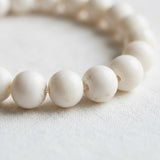


Mother of Pearl — The Graceful One
SKU:
SELECT QUANTITY
― NAMAHSUTRA ―
Mother of Pearl
The Graceful One
Grace is not the absence of difficulty. It is the quality that moves through difficulty without being diminished by it — the way water finds its path not by force but by knowing, the way moonlight does not announce itself and yet fills every room it enters. You already carry this within you. Mother of Pearl does not give you grace. It remembers it on your behalf — in the moments when the world has made you forget that you were always made of something luminous.
Born of the Ocean's Most Patient Act — Layer Upon Layer, Over Years
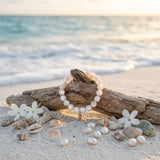
Mother of Pearl is not mined from the earth. It is grown — secreted, over years, by living mollusks as an act of biological intelligence so elegant it has become one of the most studied structures in modern materials science. When a foreign irritant — a grain of sand, a parasite, a fragment of shell — enters the body of an oyster, mussel, or abalone, the mollusk responds not with rejection but with enclosure: specialised cells in the soft inner mantle tissue begin secreting the substance known as nacre, coating the intrusion in concentric, iridescent layers until it is transformed, over months and years, into something entirely different from what it began as. This same secretion lines the interior of the mollusk's shell, creating the luminous inner surface we call Mother of Pearl — the literal container and genesis of every natural pearl in existence. The name itself comes from the Latin mater perlarum: the mother of pearls. The finest deposits come from the warm, mineral-rich waters of Australia's northern coast, where the silver-lipped pearl oyster (Pinctada maxima) produces the largest and most resplendent nacre in the world; Japan, where centuries of pearl cultivation have produced nacre of legendary refinement; the Philippines, whose tropical waters yield abalone and oyster shells of extraordinary chromatic range; and the Persian Gulf, one of the oldest pearl-diving traditions on earth, where nacre has been harvested since before written history. Each geographic source produces a nacre with its own optical character — the Australian material is bold and silver-white, the Japanese refined and deeply iridescent, the Persian Gulf warm and creamy in tone. What every source shares is the same founding act: a living creature, responding to disruption with the slow, patient work of making something beautiful.
Four Thousand Years of Luminosity — From Mesopotamia to the Imperial Courts
Mother of Pearl is among the oldest decorative materials in human history, with documented use extending back to at least 2500 BCE in ancient Mesopotamia, where nacreous inlays have been found in furniture, musical instruments, and ceremonial objects recovered from the royal tombs of Ur. In ancient Egypt, nacre was carved into cartouches, beads, and decorative inlays for temple furnishings and funerary objects — prized for its association with the Moon, with water, and with the divine feminine principle embodied by Isis. The Chumash and Tongva peoples of southern California inlaid iridescent abalone into their ocean canoes and wove shells into burial rituals and rainmaking ceremonies — understanding the material as a living connection between sea and sky. In East Asia, the relationship between Mother of Pearl and art reached its most sophisticated expression. Chinese artisans used nacre in lacquerwork from at least the Shang dynasty; by the 12th century, craftsmen had developed techniques for cutting nacre into thin sheets fine enough to depict entire landscapes — mountains, rivers, figures, and narrative scenes — embedded within polished lacquer surfaces. The Korean technique of najeon — nacre inlaid in lacquerwork — spread from Tang dynasty China to the Korean peninsula, reaching its zenith during the Goryeo period when pieces were considered worthy of gifting to the imperial palace. Japanese craftsmen employed Mother of Pearl in lacquerware and sword fittings from the Heian period onward, developing an aesthetic language in which nacre represented both the beauty of transience and the quiet authority of the natural world. In medieval Europe, nacre adorned religious crosses, reliquaries, and devotional objects — its iridescence understood as a visual equivalent of divine light, present and shifting, never fully graspable. In the Georgian and Victorian eras, Mother of Pearl became the material of intimate personal objects: brooches, combs, lockets, buttons — the small, daily-carried things that women touched without thinking, reaching instinctively for something that had always carried the quality of the sea.
Aragonite Architecture — The Strongest Structure Nature Has Ever Invented
Mother of Pearl is composed of 95% aragonite — a crystalline polymorph of calcium carbonate (CaCO₃) — with the remaining 5% consisting of organic materials including conchiolin (a structural protein), glycoproteins, chitin, peptides, and lipids. This minority organic fraction is, however, the structural secret of nacre's extraordinary properties. The material is organised at the nanoscale in what materials scientists describe as a "brick-and-mortar" architecture: hexagonal aragonite tablets, each only a few hundred nanometres thick, are arranged in precise tiled layers, with thin sheets of elastic organic material cushioning each interface. When force is applied, this structure does not crack. Instead, the organic layers allow the aragonite tablets to slide and lock — deflecting crack propagation and absorbing impact — before returning to their original configuration without loss of strength. The result is a material that is, by weight, among the strongest in the natural world: research has demonstrated protective nacre-derived coatings that are 8 times lighter and 14 times stronger than steel. The characteristic iridescence is produced not by pigment but by physics — specifically, the optical phenomenon of thin-film interference. Light entering the layered nacre structure undergoes both constructive interference (where waves align and amplify colour) and destructive interference (where waves cancel and dim colour), with the number, thickness, and viewing angle of the layers determining the precise spectral range visible at any given moment. This is why Mother of Pearl appears to shift colour as it moves: it does not contain all colours simultaneously. It reveals them sequentially, as the angle changes. There is no hardness rating on the Mohs scale for Mother of Pearl as a standard mineral — it is an organic-mineral composite, typically rating between 2.5 and 4.5 depending on species and formation, with a specific gravity of approximately 2.60 to 2.78. Its biocompatibility has made it a subject of active medical research: nacre stimulates osteoblast activity and has demonstrated potential as a substitute material in bone graft procedures. A living ocean, compressed into architecture at the scale of light.
Crown & Heart — The Channel Between Divine Intelligence and Human Love
Mother of Pearl carries a dual chakra resonance of particular elegance: its primary alignment with the Crown Chakra (Sahasrara) and its secondary, equally vital relationship with the Heart Chakra (Anahata). The Crown, located at the apex of the body, governs the individual's connection to a consciousness that is larger than the personal self — to intuition that arrives without explanation, to the quality of knowing that precedes thought, to the experience of being guided rather than merely deciding. When Sahasrara is open, the person does not merely think their way through life. They sense it: they feel the current of what is right before it can be articulated, and they move with it rather than against it. Mother of Pearl — formed in water, aligned with the Moon, carrying the frequency of patient, layered accumulation — works with the Crown Chakra in the way the ocean works with the shoreline: not by force, but by consistent, tidal presence that shapes everything it touches over time. When the Crown is contracted or clouded, intuition becomes anxiety — the same inner signal that should be guidance begins to manifest as unease, as the inability to trust one's own perception, as the exhausting habit of second-guessing what is clearly known. Mother of Pearl dissolves this particular cloudiness with exceptional precision. It does not amplify psychic ability in a dramatic sense. It restores the signal clarity of the intuition that was always there, quieting the interference so that what is genuinely known can be heard. The secondary Heart Chakra connection brings this clarity downward into the domain of relationship, compassion, and emotional intelligence — creating an integrated channel in which what is perceived at the Crown can be felt and expressed at the Heart. The result is not merely intuition alone, nor compassion alone, but the specific quality that arises when both are present simultaneously: grace — the capacity to respond to the complexity of human life from a place of both understanding and tenderness.
Mother of Pearl carries the ocean's frequency in its structure — the quality of water that is moved without being disrupted, that receives everything and is altered by nothing at its depths. Worn daily, it introduces this same quality into the nervous system: a calm that is not the suppression of feeling, but its steady, unhurried movement. For those whose inner landscape tends toward constant motion, it is the first sustained stillness they have felt in a long time.
The Moon governs both the ocean's tides and the human body's most instinctive knowing — and Mother of Pearl, formed in lunar-aligned water and carrying Chandra's frequency at its core, restores the signal clarity of intuition that has been dulled by noise, obligation, or the long habit of deferring to external opinions over internal perception. The knowing was always there. This stone simply turns down the interference so it can be heard.
Mother of Pearl's protective quality is not the confrontational kind — it does not block or deflect with force. Like nacre itself, it creates a protective layer through enclosure: wrapping the wearer's energetic field in the same iridescent buffer that a mollusk builds around an irritant, transforming what enters into something that can no longer cause harm. In metaphysical tradition, this quality has been understood for four millennia as one of the most reliable protections available — soft in appearance, impenetrable in effect.
Grace — the quality of moving through difficulty without contracting, of maintaining composure without suppression, of responding from the widest possible version of yourself even when the circumstances are narrow — is not a temperament. It is a practice, and it requires a frequency of sustained equanimity that Mother of Pearl provides in precisely the form it is most needed: not as distance, but as depth. When the world presses, the stone offers something to stand in that does not require you to diminish.
The dual Crown-Heart chakra activation creates an unusual and precise integration: the capacity to feel fully without being overwhelmed, and to perceive clearly without becoming detached. For those who tend to oscillate between emotional immersion and emotional distance — between feeling everything and feeling nothing — Mother of Pearl provides the middle register: the place where emotion is honoured, processed, and released with the same patient, layered intelligence with which nacre is formed.
The one who moves through life with apparent ease and is privately exhausted by the sustained effort of it — who maintains grace publicly and rarely finds the space to put it down, and who has been quietly waiting for something that holds them with the same quality of care they extend so freely to everyone else.
The one whose intuition is extraordinary but whose trust in it is not — who knows, with a certainty that lives below the level of thought, what is true and what is right, and who has learned, through years of being told to be rational, to second-guess the very intelligence that has never once misled them.
The one who has moved through significant disruption — loss, transition, the sustained pressure of circumstances that did not relent — and who is ready not to recover in the sense of returning to what was before, but to emerge into what comes next with the particular luminosity of someone whose depth was formed, not diminished, by what they endured.
The one who is drawn to beauty not as vanity but as a form of attentiveness — who understands that to notice the quality of light on water, to care for the objects they wear and the spaces they inhabit, is not a luxury but a practice of being fully present to the life they are actually living.
The one who gives, and gives, and gives again — whose instinct is always outward, always generous — and who has never quite learned to let the Moon refill what the day empties, and is ready, finally, to understand that receiving is not weakness but the other half of what makes giving sustainable.
Wear Mother of Pearl on your left wrist. The left side of the body is the receiving channel — the direction through which energy enters the personal field rather than is expressed outward. Mother of Pearl's primary work is receptive: it calms, it restores, it opens the Crown and Heart to receive what they need from the wider field of lunar intelligence. Worn on the left, it moves with the body's natural receptive current — entering quietly, working with the same patient, cumulative logic with which nacre itself is formed: not dramatically, but layer by layer, until the difference is undeniable.
Begin wearing on a Monday. Monday is governed by the Moon — Chandra — the ruling planet of Mother of Pearl and the celestial body most closely aligned with the ocean, with tidal rhythm, with the intuitive intelligence that operates below the surface of conscious thought. Beginning on a Monday aligns the bracelet's first activation with the peak of Chandra's weekly frequency, creating an immediate and intuitive resonance between the stone's formed-in-water nature and the lunar energy that has always governed it. There is something fittingly quiet about beginning on a Monday — the day that does not announce itself, that simply arrives and begins.
Set your intention before first wearing. Hold the bracelet in both open palms. Close your eyes and breathe slowly — four counts in, a gentle hold, six counts out. Feel the weight of the beads: smooth, cool, formed over years in moving water. With the first exhale, release one quality you have been carrying that is not yours — someone else's urgency, expectation, definition of who you should be. With the next inhale, name what you are reclaiming: calm, clarity, grace, the unhurried trust in your own knowing. Place the bracelet on your left wrist with the understanding that this stone has been building its frequency for far longer than any anxiety you are currently carrying. It is patient. It has time. It will do its work.
Wear continuously for 21 days. The properties of Mother of Pearl accumulate rather than announce — like nacre, they work in layers, each day adding to what the last established. The 21-day threshold is where the stone's frequency moves from something you notice when you put it on to something that has become indistinguishable from your own resting state. Remove only for the specific care practices described below, and only briefly. After 21 days, the quality of calm it carries will feel less like something you are wearing and more like something you have always been.
- ✦ Full Moon Recharge Monthly. Place your Mother of Pearl bracelet on a windowsill or outdoors in full moonlight for 4 to 6 hours. This is the single most natural and powerful recharging method for this stone — formed in water, named for the Moon, and structurally attuned to Chandra's frequency. The full moon's reflected light is energetically native to Mother of Pearl in a way that no other charging method matches. This monthly ritual is not optional care — it is the stone returning home.
- ✦ Wipe With a Soft, Slightly Damp Cloth. Use a soft, lint-free cloth — barely dampened with clean, lukewarm water — to gently clean the bead surface after wearing. Mother of Pearl is an organic-mineral composite and benefits from a small amount of moisture to maintain its surface lustre and prevent the thin nacre layers from drying and becoming brittle over time. Dry immediately with a second soft cloth. Do not use dry polishing cloths with abrasive compounds.
- ✦ Smoke Cleanse Every Two to Three Weeks. Pass the bracelet through the smoke of sage or palo santo for 20–30 seconds. As a stone aligned with emotional and intuitive work — absorbing the field energy of the Crown and Heart chakras it serves — Mother of Pearl benefits from regular energetic discharge. Smoke cleansing is gentler on the organic component of nacre than water-based methods and can be performed safely and regularly without risk to the surface.
- ✦ Store in the Velvet Pouch, Away From Other Stones. Mother of Pearl's hardness of 2.5 to 4.5 makes it susceptible to surface scratching from virtually every other gemstone in existence. Always store it separately in the provided velvet pouch, never loose with other bracelets or crystals. Even soft cloths with embedded dust particles can scratch nacre's surface over time. The velvet pouch is the appropriate environment for this stone between wearings.
- ✦ Handle With Intention and Consistency. Mother of Pearl is a living-origin material — formed biologically, retaining a structural relationship with organic matter. Consistent, intentional daily handling maintains the warmth of the stone's surface and keeps its energetic field active and aligned with the wearer's own field. Like most organic materials, it responds well to regular use and regular care. Neglect — long periods unworn and uncleaned — dims both the visual lustre and the energetic clarity more quickly than any single adverse event.
- — All Chemicals and Acidic Substances. Mother of Pearl is composed primarily of calcium carbonate — a compound that reacts with acids. Perfumes, hairsprays, cleaning products, hand sanitisers, sunscreen, and even sweat with high acidity content will etch and dull the nacre surface over time, dissolving the thin aragonite platelets that produce its iridescence. This damage is cumulative and irreversible. Apply all products before wearing and never spray directly near the bracelet.
- — Extended Water Immersion or Soaking. While Mother of Pearl originates in water, prolonged immersion — particularly in chlorinated pools, salt water, hot tubs, or soapy bath water — is harmful to both the nacre surface and the organic binding layers within it. Chlorine is particularly corrosive to the protein conchiolin that holds nacre's aragonite layers together. Remove before bathing, swimming, and washing dishes as a consistent practice.
- — Prolonged Direct Sunlight or Heat. Unlike many minerals, Mother of Pearl contains living-origin organic components that are sensitive to desiccation. Prolonged exposure to strong direct sunlight — particularly in dry climates — depletes the moisture in nacre's organic matrix, causing the aragonite layers to lose cohesion and the surface to become chalky, crazed, or flaked. Avoid leaving the bracelet on a sunlit surface or in a hot car. Brief, diffuse daylight is fine; sustained intense heat is not.
- — Abrasive Cleaning Methods. Ultrasonic cleaners, steam cleaners, abrasive polishing cloths, toothbrushes, and any mechanical cleaning method will cause irreversible surface damage to nacre. The iridescent quality of Mother of Pearl is produced by the precise layering of the outermost nacre surfaces — and any abrasion that disrupts this micro-architecture destroys the optical effect permanently. Soft cloth and gentle moisture only.
- — Contact With Harder Stones or Materials. At a hardness of 2.5 to 4.5, Mother of Pearl is one of the softest materials in the NAMAHSUTRA collection. Metal clasps, keys, hard jewellery surfaces, ceramic, and virtually all other gemstones will scratch nacre on contact. Never store it loose in a jewellery drawer or bag with other pieces. The velvet pouch is its only appropriate companion.
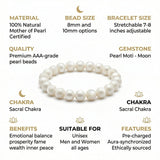
| Stone | Natural Mother of Pearl (Nacre) — Australia, Japan, Philippines, Persian Gulf |
| Composition | Aragonite (CaCO₃) 95% · Conchiolin & organic proteins 5% |
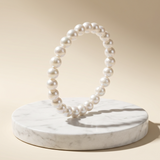
| Bead Size | 8 mm · Round · Natural Formation |
| Quality | AAA++ Premium Grade |
| Chakra | Crown (Sahasrara) & Heart (Anahata) |
| Planet | Moon (Chandra) |
| Design | Stretchable · Unisex · Mindful Daily Wear |
| Authenticity | 100% Natural · Lab Certified & Verified |
| Packaging | Premium Black Gift Box · Velvet Pouch Included |
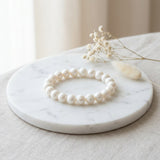
Every Mother of Pearl bead in this bracelet is entirely natural — formed over years inside living mollusks in the warm, mineral-rich waters of the Indo-Pacific and Persian Gulf. No two beads carry an identical iridescence. The luminous quality you observe — that shifting, spectral play of light across the bead surface — varies in its exact chromatic range, intensity, and directional movement from bead to bead, shaped entirely by the precise layering of aragonite platelets within each individual shell, the species of mollusk that formed it, the temperature and mineral composition of the water it grew in, and the years it took to reach the thickness from which your bead was cut. Some beads will carry a cooler, silver-white iridescence; others a warmer, cream-toned shimmer with rose and gold undertones. You may notice subtle tonal gradations across your bracelet — a bead that catches the light in one direction differently than in another, a variation in the depth of the nacre's glow between adjacent beads. These are not inconsistencies in quality. They are the record of the ocean's signature on each individual piece of shell — the irreproducible, biological autobiography of a material that was grown, not made. What appears uniform under a photograph is never, in the hand and on the wrist, anything less than entirely singular.


